



Writer: Laiba Sahar
Issues of opportunity and challenge for Tharparkar’s youth — but where are the opportunities?
Tharparkar is synonymous with desert, culture and resilience. However, something else needs to be considered in 2026: what opportunities do the young people who reside there actually have?
It’s not as if Tharparkar doesn’t have talented youth. It does. The issue is whether the government’s education and development system is reaching them rapidly, in quality and consistency.
Sindh School Education and Literacy Department documented several education related interventions in the Tharparkar area in 2026. Three Schools (GBPS Tilwayo and GBLSS Warwai, Islamkot; GBPS Shafi Muhammad Paro, Nagarparkar) were upgraded in March in the district.
The department also made the joining database of 169 newly recruited JEST teachers of Tharparkar in May for the release of salaries.
But these statistics also pose a more significant question, which is whether the government is using the number of notifications sent as the measure of success or whether opportunities are actually reaching students?
An upgraded school on paper is not sufficient if the school doesn’t have laboratories, library, access to digital resources and doesn’t have trained teachers or avenues for further studies. In a similar way, the recruitment of teachers is required, but the key factor is if the teachers are in place, supported and can enhance learning outcomes.
The challenge is made even more complex if we consider settings beyond the classroom.
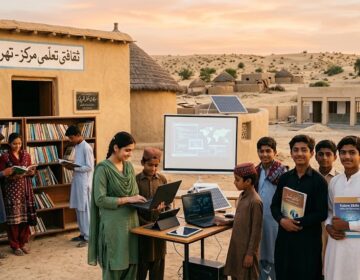
A youngster in Tharparkar demands more than a school certificate. They require technical training, access to computers, internet, career counselling, internships, entrepreneurship programme and employment opportunities. With a modern, tech-driven and remote working economy, these opportunities can be a disadvantage in the geographical location.
This is where the question of administrative structure can not just be brushed aside.
The district of Tharparkar is a large district with scattered communities in a challenging terrain. How easy is it for a young person from a distant area to access government offices, education, training or development decisions if they are localized?
The answer is obvious; can a large population spread out across a wide area be given administrative care in a place built to oversee such an area?
It’s not just a case of simply creating a new administrative unit and the problem goes away. A new district, subdivision or administrative structure would only make a difference in terms of decision-making, resource allocation, monitoring and public services if it moves them closer to people.
However, in a real attempt to increase opportunity, administrative accessibility must be on the agenda.
The Government of the State of Sindh is speaking about the empowerment of youth, digital skills and employability. The information-technology programmes of its describe free IT training, digital literacy, freelancing and remote work as ways for young people.
The obvious question that naturally arises is whether such programmes exist on paper. Where are these opportunities reaching a youth in Tharparkar?
But if access is limited to a select few young people, what will stop them from being drawn further into the district?
There are examples also which demonstrate the potentialities that Tharparkar’s students can attain in the presence of opportunities. On completion of 22 approved STEAM activities, GBHS Kantio, Tharparkar has been named as one among the top 10 schools in Sindh by the Sindh School Education & Literacy Department in Feb 2026.
It is not enough to celebrate this achievement. It should pose yet another question: How many other students would be capable of this if others had similar opportunities distributed throughout the district?
The young people of Tharparkar aren’t without potential. But it remains to be seen if the environment they are in is able to deliver the opportunity to match that potential.
The discussion should go beyond symbolic development announcements, therefore. It should question whether schools are effective, whether teachers are effective, whether youths have access to digital and vocational skills, whether there are career pathways other than migration, and whether the administration is near enough to address local needs.
The real challenge for Sindh in 2026 is not just to develop Tharparkar.
The purpose is to bring development as near to its people as possible, to ensure that a young person’s destiny isn’t decided by how far away his place of birth is from the institutions that are supposed to serve him.
The younger generation of Tharparkar cannot be considered as beneficiaries of government schemes only. They should be regarded as the human resources of the region for its future.
So the debate about the potential of Tharparkar is no longer on the table.
The challenges are whether governance is being realised to that extent.