





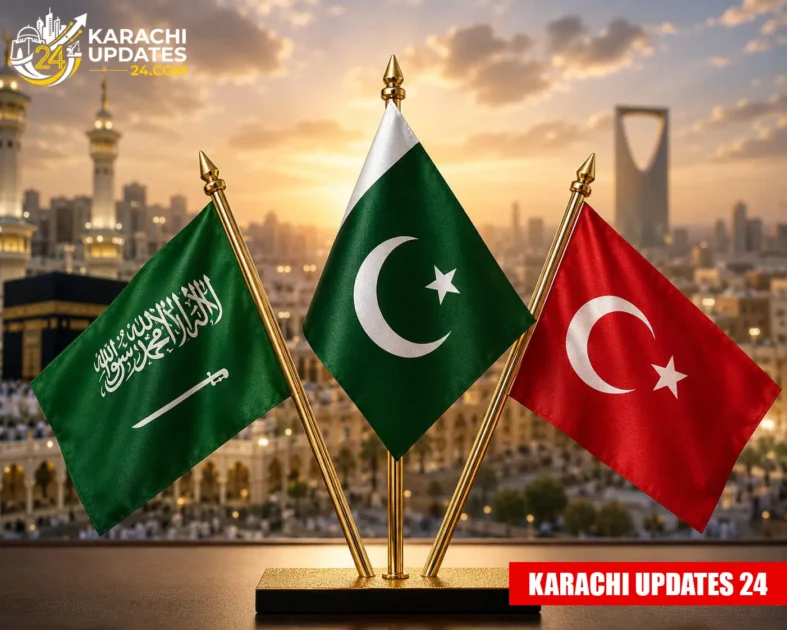

The “defence agreement” signed in Makkah by Pakistan, Saudi Arabia and Türkiye is significant in the changing course of security dynamics in the Muslim world. The deal comes in a period of heightened uncertainty in the Middle East and the broader region, and it is good to see the two parties being united in their goals of enhancing deterrence, strategic coordination and collective security.
The main tenet of the deal is the simple one that if any of the three countries attacks one, it attacks all. The exact military mechanisms and requirements of this accord will vary depending on how it is applied, but its political impact is already huge. It is a clear indication of Pakistan’s, Saudi Arabia’s and Türkiye’s willingness to further strengthen security cooperation and lean on their own strategic strength.
The implications of the agreement for Pakistan are far more than defense related.
Pakistan is to bring this partnership with a special mix of military strength, strategic location, and diplomatic history. Pakistan is a country of strategic significance as it is the crossing point of the three continents i.e South Asia, Central Asia and Middle East and is a nuclear state. It has one of the most experienced militaries in the region and its defence ties with Saudi Arabia have been in existence for a while, providing Islamabad with a solid base for further defence cooperation.
Pakistan’s contribution will be crucial as Saudi Arabia and Türkiye will be adding complementary strengths. Saudi Arabia has vast economic potential, and a pivotal position in the Gulf, whilst Türkiye has a mature defence sector, NATO experience and influence increasing in the Middle East. Pakistan, on the other hand, will be providing military capability, strategic deterrence and decades of defence cooperation with both nations.
These capabilities, combined, form a strategic alliance with significant potential.
The main idea of the agreement is deterrence. In international relations, credible deterrence is a means to make an attack more costly, rather than a means to start an attack. The three nations are trying to make it harder and more expensive for any adversary to attack one country and then the other following a response.
This is especially true for Pakistan. Islamabad has been working for long to safeguard its national interests without getting into any unnecessary conflict away from its borders. Instead, a more robust collective-security mechanism can help provide Pakistan with greater strategic depth, and not necessarily at the expense of its longstanding wariness of regional crises.
The agreement will also be useful for Pakistan’s foreign policy.
Islamabad has vital strategic relations with China, Saudi Arabia and Türkiye and is continuing its diplomatic efforts with the United States and neighbouring Iran. It is not only confined to one geopolitical camp, Pakistani engagement with various partners has been diversified on national interest basis. In this context, the Makkah agreement could be viewed as part of a bigger plan in which Pakistan’s influence is extended throughout the Muslim world and beyond the Gulf.
Saudi Arabia has a proven and reliable military ally in Pakistan. The agreement will also be used to further Türkiye’s role in the region as a security force. For Pakistan, however, the benefits may be especially pronounced, as it could help solidify a reputation of a strong security ally whose military and strategic heft is not confined to South Asia.
The agreement has also a wider message that regional ownership of security. The Middle East has long relied on outside actors to maintain a certain degree of security. The increased regional cooperation indicates a desire for the creation of further mechanisms for regional countries to defend their interests and react as a region to new threats.
But it is not to suggest the emergence of an “Islamic NATO”. Comparing such things is too early. NATO has decades of experience in institutional development, in integrated military structures, and command mechanisms. Such an alliance would not be comparable with the Makkah agreement until it is well institutionalised.
But its potential is not to be discounted.
The deal could be slowly transformed into a more-powerful regional security alliance if Pakistan, Saudi Arabia and Türkiye move into joint military drills, intelligence sharing, defence-industrial cooperation and joint security mechanisms.
Pakistan can certainly take advantage of this opportunity and also carry responsibilities. Islamabad has to take care that its growing military relations build national sovereignty and strategic autonomy without unnecessary confrontation with the neighbouring countries. It is Pakistan’s job to strengthen the position of stability and not be another player in the game of polarisation in the region.
Ultimately, the impact of Makkah Defence Pact will be measured not just on what was signed but on what the three states erect from it.
But the message is already important to Pakistan. The country does not just respond to geopolitical changes in the surrounding world. It possesses military power, a strategic location and diplomatic ties that make it important to observe in the security landscape of the larger region.
It is possible, then, that the Makkah pact could turn into more than a defence pact. It might be a significant move towards Pakistan becoming a consequential regional security power.