



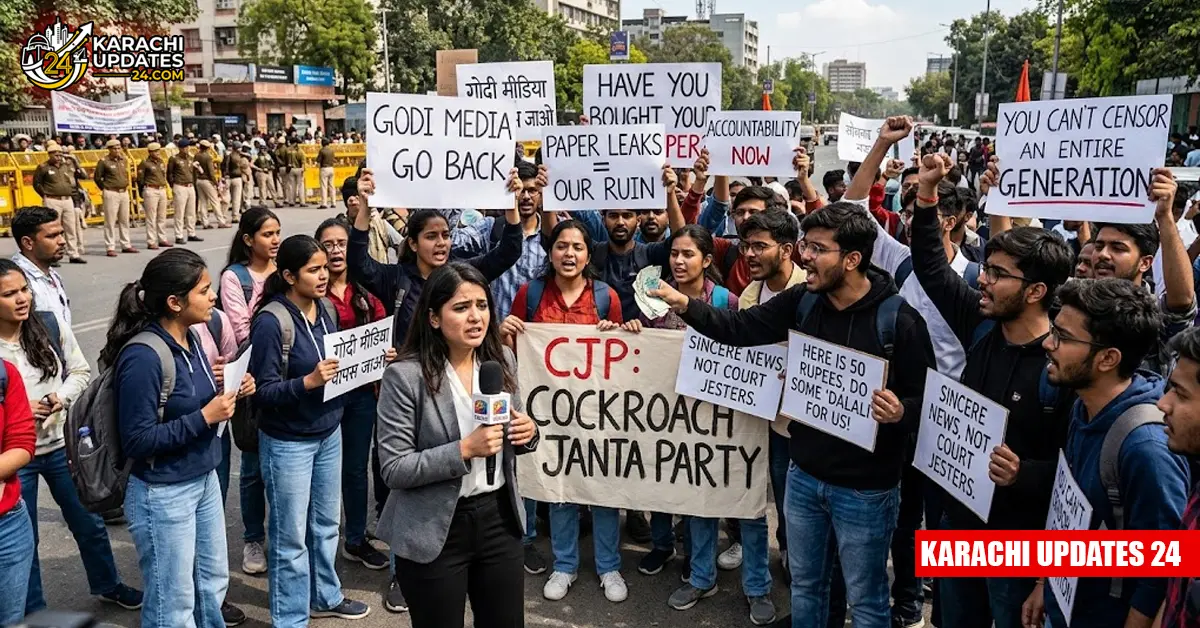

There is a quiet, suffocating irony in watching a nation of a billion-plus people discover that their loudest television screens are nothing more than speakers , sounding the alarm of Modi government’s inner panic.
For over decades, Indian television news has operated like a grand, high-budget illusion. The anchors sit inside climate-controlled, glass-walled studio fortresses, draped in synthetic solemnity, acting as the high-priests of a manufactured reality. In this fantasy, the ruling dispensation is infallible, dissent is treason, and the microphone is a weapon used not to question power, but to bludgeon the powerless. But reality has a crude, unmanageable habit of breaking through glass.
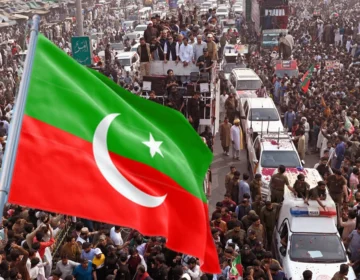
Walk down the blocked streets of New Delhi today—past the heavy security cordons, the tear gas residue, and the lingering echoes of the brutal crackdowns on youth protesting against systemic exam paper leaks—and you will witness a profound philosophical breakdown. You see the exact moment a public realizes that the people holding the mics are not journalists reporting the news; they are court jesters singing for their supper.
For nearly a month, mainstream networks like ANI, NDTV, Aaj Tak, Zee News, and News18 tried a remarkably medieval trick: they pretended the protests didn’t exist. If the cameras don’t show the thousands of students marching under the banner of the Cockroach Janta Party (CJP), or the pre-dawn police abduction of 59-year-old climate activist Sonam Wangchuk after his 21-day hunger strike, then surely the unrest will evaporate into thin air. Studio stars spent hours weaving elaborate conspiracy theories, blaming foreign shadows, and branding every student, job aspirant, and citizen demanding accountability as anti-national, urban Naxals, or deep-state operatives.
And then, CJP happened. When the insulation of the studio finally met the friction of the asphalt, the collision was theatrical and poetic. Junior reporters sent out to cover the groundswell were suddenly greeted not by polite soundbites, but by angry crowds chanting, “Godi Media Go Back!” Students held out fifty-rupee notes, mocking the anchors with biting sarcasm: “How much did Modi pay you to shill for the government? Here, take fifty rupees and do some _dalali_ for us!”
It is a stunning fall from grace for anchors who spent years acting as the foot soldiers of political authoritarianism, distributing digital patriotism certificates and running communal dog whistles on a loop. Yet, even now, these prime-time gladiators lack the raw courage to step out onto the pavement themselves. They stay locked behind their studio desks, sending terrified junior crews to absorb the wrath of a public that has simply, irrevocably, grown sick of them. The descent of Indian television into absolute farce isn’t new, of course; it is a long-standing tradition that scales up dramatically whenever Modi finds himself in a tight corner.
One only needs to cast their mind back to the bizarre theatrics surrounding Operation Sindoor. While Pakistani media outlets maintained relative composure and institutional discipline during those tense military flare-ups, Indian newsrooms transformed into hysterical hyper-war-rooms. Anchors dressed up in mock-military camouflage, screaming at invisible phantoms, drawing cartoonish nuclear apocalypses with primitive CGI graphics, and behaving as though they were personally directing missile strikes from the news desk. It was a bizarre cross between a religious revival meeting and a bad military cosplay.
Yet, when real, unscripted domestic crises hit home—when young Indians are crushed by paper-leak mafias, when police boots trample the national tricolor in the dust of New Delhi, and when the state turns its capital into a militarized war zone against its own children—these very same studio warriors suddenly develop selective amnesia. They look at government handlers, like Amit Shah outside Parliament yesterday., with wide-eyed, puppy-dog devotion, cooing, “Wah wah sir, what a _sundar_ new dress!”
The consequences of this institutional sycophancy are written clearly in global indexes. India’s tumble to 157th out of 180 countries in the World Press Freedom Index isn’t just a statistical metric; it is the epitaph of a once-proud journalistic tradition. The public backlash is so fierce that even right-wing influencers are now unironically begging the government to ban Instagram and Facebook—waking up too late to the reality that social media algorithms are infinitely harder to censor than a panel of paid studio guests.
When a society’s media becomes a megaphone for tyranny, the streets inevitably reclaim the headlines. The scripts are burning, the studio armor is cracking, and the youth of India are making it clear: you can censor a broadcast, but you cannot make an entire generation your mouthpiece. This is a generation demanding its future back, this is Gen-z!