




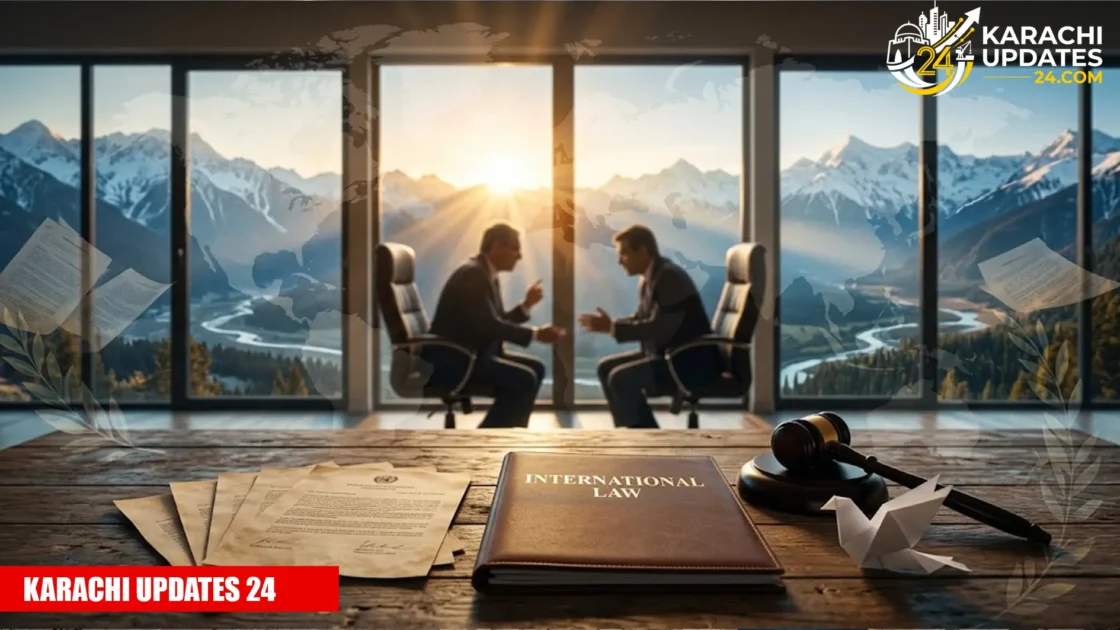

The assertion that bilateral talks with Pakistan must focus solely on a
restricted agenda is often presented as a resolute diplomatic posture. However,
the reality remains that a unilateral political declaration by any state can
neither rewrite history nor reshape international law. It cannot dissolve a
dispute that the United Nations Security Council has recognized in its archives
for decades. Attempting to characterize the Kashmir issue as resolved through
domestic political declarations represents an escape from reality rather than
its resolution.
Kashmir is not merely a political disagreement between two neighboring states.
As early as January 1948, the United Nations Security Council, through
Resolution 38, formally addressed the situation and called upon both nations to
improve the environment. Subsequently, the Security Council adopted several
resolutions concerning the constitutional and political status of the territory.
Resolution 98 of 1952, for example, outlined negotiations regarding a
demilitarization plan for the state of Jammu and Kashmir, while Resolution 122
of 1957 remained focused on the question of a final settlement.
To argue that a unilateral claim represents the final legal reality is to ignore
both history and global diplomacy. In August 2019, the United Nations Secretary
General clarified that the position of the world body on Jammu and Kashmir is
governed by the UN Charter and relevant Security Council resolutions. This
statement also referenced the 1972 Simla Agreement, noting that the final status
of Jammu and Kashmir must be settled by peaceful means.
A fundamental question arises: if the issue has indeed been resolved, why does
such intense political and military sensitivity persist? If one party could
alter the legal status of a dispute through parliamentary speeches, official
decrees, or displays of force, the very foundation of international law,
bilateral treaties, and United Nations resolutions would be rendered obsolete.
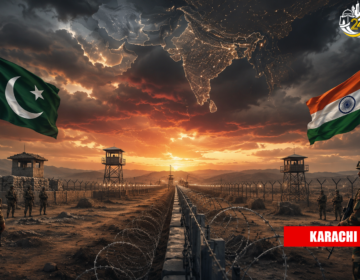
The pursuit of force has not brought peace to South Asia. Instead, it has eroded
trust, heightened military tensions, and rendered a region where two nuclear
armed states face each other increasingly volatile. In the Lahore Declaration
of 1999, both countries agreed to resolve all issues, including Jammu and
Kashmir, through peaceful means, while also committing to strengthen bilateral
dialogue and reduce nuclear risks.
The lessons of history suggest that threats cannot substitute for dialogue,
political provocation does not offer solutions, and military pressure cannot
render a disputed territory legally undisputed.
This raises important questions regarding domestic political dynamics. When a
large nation experiences growing youth unrest, employment challenges,
educational crises, or economic pressures, focusing on an external adversary
often becomes an accessible political narrative. This observation points to a
well recognized pattern in political communication, which is particularly
relevant given current domestic developments.
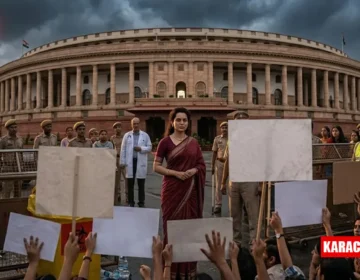
In July 2026, widespread youth protests in India highlighted public discontent
regarding the examination system, employment opportunities, and governance
accountability, eventually leading to the resignation of the education minister.
Reports from Reuters indicated that youth unemployment had reached 9.9 percent,
which was more than three times the national average, in a country where nearly
two thirds of the population is under the age of 35.
Economic challenges also persist. A Reuters economic survey from July 2026
projected that India’s economic growth rate would moderate to approximately 6.6
percent in the fiscal year 2026 to 2027, down from 7.7 percent in the previous
fiscal year. This moderation comes amid risks posed by elevated global oil
prices and subdued private investment.
In such a environment, maintaining a political focus on Pakistan and Kashmir
does not address these domestic issues. The youth require employment, students
demand transparent examinations, families seek economic security, and citizens
deserve accountable governance. These demands cannot be addressed by focusing on
external adversaries.
Consequently, the response from Pakistan should not be guided by emotional
rhetoric. It must remain anchored in international law, principled diplomacy,
historical records, and a responsible defense posture. The objective should be
justice over conflict, dialogue over threats, and credible diplomacy over
political slogans.
For genuine peace to take root in the region, there must be an understanding
that silencing a territory and resolving its core dispute are two fundamentally
different objectives. Unilateral political declarations, military pressure, or
continuous provocation cannot dissolve the reality of a dispute.
The security of millions of people in South Asia outweighs temporary political
gains. Utilizing the Kashmir issue for domestic electoral advantages may
generate short term applause, but the cost of such strategies is borne by the
entire region.
Ultimately, history remembers decisions rather than slogans. In the case of
Kashmir, the final outcome will not be determined by threats, force, or
political speeches. It will be decided by reality, international law, and a
sustainable political resolution that paves the way for peace instead of
conflict.
The populations on both sides of the border consist of human beings, not mere
statistics. The primary responsibility of any leadership must be to protect the
future of these individuals rather than risking it for political expediency.